


Sponsored content: This article is produced in partnership with ZoloRides. The sponsor did not review or approve editorial content prior to publication.
Quick Takeaways
- Federal Rule: Under 49 CFR 37.167(d), every bus or van operator, public or private, must let service animals ride, and DOT’s definition covers any individually trained animal, not only dogs.
- Carrier Split: FlixBus carries no pets in the U.S., while Peter Pan accepts one dog or cat up to 25 pounds (carrier included) for a non-refundable $15.
- Crew Cost: A ZoloRides 12–15 passenger van runs $95 an hour with a 3-hour minimum ($285–$475 per van), and GOGO Charters lists minibuses at $110–$160 an hour.
- Insurance Floor: FMCSA requires $1.5 million for vehicles seating 15 or fewer, driver included, and $5 million for 16 or more.
- Honest Trade-off: ZoloRides’ SAFER record (Oct. 10, 2026) shows zero crashes and a 9.1% vehicle out-of-service rate, but a 25% driver rate against a 6.67% national average.
- Manhattan Toll: Charter buses entering below 60th Street pay $14.40 at peak and $3.60 overnight under the MTA’s Congestion Relief Zone schedule.
Fact-checked by: Alex Freeman — Transportation compliance specialist, 10+ years auditing charter and group transport operators. Full bio
Last verified: October 12, 2026
Fourteen workers. One van. A 6 a.m. pickup in Vineland for a jobsite across the county line, and two crew members who don’t travel anywhere without their dogs.
That’s when bus travel with animals stops being a pet-blog question and becomes a site manager’s problem. One dog is a trained service animal. The other is a 60-pound mutt that rides along on every out-of-town job.
The rules for those two dogs are completely different, and so are the carriers that will take them. This planning guide to bus travel with animals covers what federal law requires, what each type of operator allows, what it costs and what to ask before you sign anything.
Every policy, price and rule below was checked against carriers’ own published terms, federal regulations and the FMCSA’s SAFER database on Oct. 12, 2026. Where something couldn’t be verified, we say so.
What Bus Travel With Animals Means — And Why the Vehicle Choice Matters
For a crew, bus travel with animals breaks into three categories: service animals, emotional support animals and pets. The law treats each one differently, and getting the category wrong can leave a worker at the curb before sunrise.
Service Animals on Buses Are a Federal Right
The U.S. Department of Transportation’s ADA rules require every transportation provider, public or private, to let service animals accompany riders with disabilities in its vehicles and facilities. That’s 49 CFR 37.167(d), and it applies to an intercity coach and a 15-passenger charter van alike.
DOT’s definition is broader than the one most people know. Under 49 CFR 37.3, a service animal is any guide dog, signal dog or other animal that’s been individually trained to do work or perform tasks for someone with a disability. It isn’t limited to dogs.
Staff can ask two things: is the animal required because of a disability, and what task has it been trained to perform? There’s no official federal service-animal certificate, so ask the operator what it expects well before the trip, not at the van door. This is the one part of bus travel with animals no operator can opt out of.

Emotional Support Animals and Pets: The Operator Decides
An emotional support animal on a bus doesn’t meet DOT’s training-based definition. Neither does the 60-pound mutt. For both, the operator’s own rules decide, and those rules diverge sharply.
It’s the question every crew asks: can I bring my dog on a bus? On FlixBus in the U.S., no pets ride, though service animals and emotional support animals do. Peter Pan takes one small dog or cat in a carrier, and on a private charter the operator sets the rule for your trip.
For pets, bus travel with animals depends entirely on whose bus it is. That’s why the vehicle matters as much as the animal.
Why Vehicle Size Changes the Insurance Math
Vehicle size matters for a second reason. Under FMCSA rules, passenger carriers operating vehicles transporting 16 or more passengers (including the driver) must carry a minimum of $5 million in insurance coverage. Smaller vans transporting 15 or fewer must carry $1.5 million minimum.
FMCSA sets the required level by the largest vehicle in a carrier’s fleet, so ask for the certificate either way. For a site manager, the practical implication is floor space: a crated 60-pound dog can eat a seat’s worth of room on a van headed down Route 55, so count crates when you count heads.
What Bus Travel With Animals Actually Costs — Real Numbers, October 2026
Price only matters if the animal can board. For a 12-person crew going from Philadelphia to a Midtown Manhattan jobsite, here’s how bus travel with animals pencils out, cheapest first.
ZoloRides quotes its 12–15 passenger vans at $95 an hour with a three-hour minimum, according to its September 2026 rate card, and its site says quotes cover the van, driver, fuel and standard tolls. GOGO Charters lists minibuses at $110–$160 an hour, while Peter Pan’s Philadelphia–New York fares average $8–$30 a seat.
| Option | Base Rate | What’s Included | Surge Risk | Fixed Quote? | FMCSA Licensed? | Realistic Range |
|---|---|---|---|---|---|---|
| FlixBus (U.S. scheduled coach) | From $5.98 per seat | Seat plus one checked bag; service animals free; emotional support animals allowed; no pets | High — fares rise as seats sell | Per ticket only | Interstate carrier — verify on SAFER | About $72+ for 12 seats; pets can’t board |
| Peter Pan Bus Lines | $8–$30 per seat (Philadelphia–NYC average) + $15 per pet | Seat; one dog or cat, 25 lb max with carrier, under the seat | High — fares vary by date | Per ticket only | Interstate carrier — verify on SAFER | $96–$360 for 12 seats + $15 per pet |
| ZoloRides 12–15 passenger van | $95/hr, 3-hour minimum (rate card) | Van, driver, fuel, standard tolls (per site); pet policy not published — ask | Low — price locked at booking (per site) | Yes | Yes — USDOT 4121342 | $285–$475 per van for a 3–5 hour booking |
| GOGO Charters minibus | $110–$160/hr (published average) | Vehicle and driver; ESAs and service animals with documentation; 5-hour minimum on many trips | Medium — higher April–June and in major cities | Yes, once quoted | Books partner operators — verify assigned carrier | $550–$800 + 10–20% driver tip |
Here’s the surprise. The cheapest seat on the corridor, FlixBus from $5.98, is the one a pet can’t use at all. FlixBus doesn’t carry pets in the U.S.
Peter Pan is the budget middle ground, but only for small animals. Its bus pet policy allows one dog or cat per passenger, 25 pounds or less including the carrier, in a carrier no bigger than 19 x 14 x 10.5 inches stowed under the seat, for a non-refundable $15.
That rules out most job-site dogs. It also makes the cheapest bus travel with animals option on paper a non-starter for the 60-pound mutt.
Manhattan adds a line item. Under the MTA’s Congestion Relief Zone schedule, small trucks and charter buses entering below 60th Street pay $14.40 at peak and $3.60 overnight, while tour buses pay $21.60 at peak. Ask whether any quote’s “standard tolls” include it.
When a Private Van Is Worth It — and When It Isn’t
For crews where bus travel with animals means full-size dogs, a private van is often the only workable option. ZoloRides makes sense when the crew fits one or two vans, pickup is a yard or motel in South Jersey, and the animal question is settled in writing first.
It doesn’t make sense for a crew of 40, where a full-size coach spreads cost across more seats and ZoloRides runs vans only. And when bus travel with animals means one worker and one cat, Peter Pan’s $15 fee is hard to beat.
Real Groups, Real Trips: What the Public Record Shows
Independent reviews of ZoloRides are thin. Searches on Oct. 12, 2026 found no Trustpilot profile and no Google or Yelp ratings in web results, so the evidence here is one self-reported testimonial plus the federal safety record.
For bus travel with animals specifically, there’s no public customer record at all. Ask any operator for references from crews that traveled with dogs.
Case Study 1 — Unnamed Rider, ZoloRides Website (Self-Reported), No Star Rating, Undated
The Situation: A family group needed everyone moved to a single gathering at the same time.
What Happened: The rider credits ZoloRides with clean vans and friendly service, and says the whole group arrived together. The quote carries no name, date or star rating.
Why It Matters: It’s a self-reported line about a family event, so weight it lightly, since it says nothing about animals or job sites.
The Federal Safety Record
SAFER lists ZoloRides under USDOT 4121342 and MC-1576298 as active and authorized as a motor carrier of passengers, with 26 power units and 26 drivers as of Oct. 10, 2026. It shows zero crashes and 12 inspections over the prior 24 months.
The vehicle out-of-service rate was 9.1%, well under the 22.26% national average SAFER prints beside it. FMCSA hasn’t issued a safety rating, which means no compliance review has been done, not that one was failed. None of this is specific to bus travel with animals, but it’s the best public measure of how a carrier runs.
Not every number is clean. Three of 12 driver inspections ended with an out-of-service order, a 25% rate against a 6.67% national average. It’s a small sample, but worth asking about directly when reserving.
How to Book Without Getting Burned — A Practical Checklist
Most bus travel with animals problems start at booking, not boarding. ZoloRides’ FAQ suggests four to eight weeks of lead time for corporate trips, which is also enough time to settle which animals ride and how.
Before paying a deposit, look the operator up at safer.fmcsa.dot.gov. Confirm the USDOT status is active, the operating authority covers passengers, and the insurance on file fits the vehicle you’re booking.
Then get the quote itemized: driver, fuel, tolls, the Manhattan congestion toll if it applies, gratuity and any cleaning fee for animal hair. ZoloRides says its price covers the van, driver, fuel and standard tolls, so ask in writing how it handles gratuity and cleaning.

On long runs, bus travel with animals means planning stops. Traveling with dogs by bus or van needs water and a relief walk every few hours, and no animal should wait in a parked van at a New Jersey Turnpike service area in July.
Stops line up with the driving rules anyway. FMCSA caps passenger-carrying drivers at 10 hours behind the wheel after 8 consecutive hours off duty, so a long haul to an out-of-state site may need a second driver regardless.
Then sort out the people side. A crew member’s allergy or fear of dogs is a real seating problem, but fear alone isn’t grounds to refuse a service animal, so plan seats, not exclusions.
If you’re planning recurring construction crew transportation, ZoloRides’ bus transport solutions page outlines multi-van crew moves. Its quote request asks for date, pickup, destination and group size, so add the animal list there.
Booking Checklist — Save or Screenshot This
- FMCSA/USDOT registration verified at safer.fmcsa.dot.gov
- Insurance certificate confirmed ($1.5M for vehicles seating 15 or fewer including the driver / $5M for 16 or more — per FMCSA)
- Written all-in quote: tolls + NYC congestion fee + gratuity policy + any cleaning fee
- Vehicle type and exact capacity confirmed in writing, with crate space counted
- CDL passenger endorsement and background check confirmed
- Bus travel with animals list sent in writing: species, weight, and whether each is a service animal, emotional support animal or pet
- Rules for pets on buses or vans confirmed, including pet carrier size for bus travel and leash or crate requirements
- Cancellation and group size change policy in writing
- NYC DOT compliant pickup/drop-off zones confirmed
- Quote from at least one other provider obtained
The Industry in Honest Terms — How Bus Pet Policy Really Works
Intercity buses carried about 50 million passengers in 2023, according to DePaul University’s Chaddick Institute, and the big networks keep animals to a minimum. Rules on bus travel with animals split cleanly along business models.
Scheduled national carriers are strict about pets but open on support animals. FlixBus, which also runs Greyhound in North America, carries no pets in the U.S., yet its help center says service animals ride at no extra charge and emotional support animals are allowed too.
Northeast regionals are friendlier to small pets. Peter Pan and C&J both take small cats and dogs in carriers for $15, and C&J treats emotional support animals as pets under the same rules.
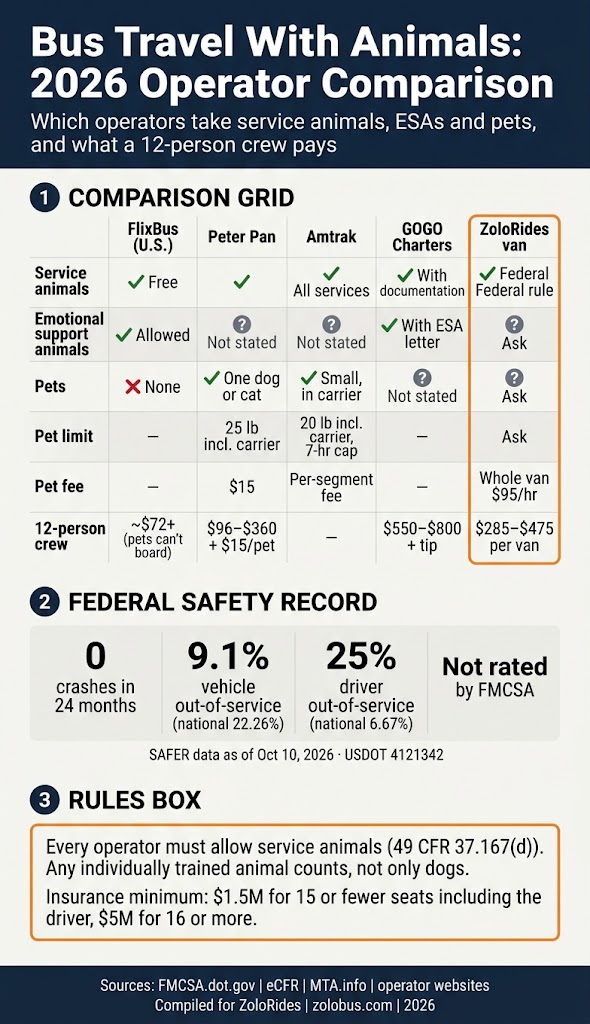
Charter works differently because you rent the whole vehicle. GOGO Charters, which books trips through partner operators, says registered emotional support and service animals are allowed on all its rentals once a sales rep receives an ESA letter or service-animal certification.
That’s a clear charter bus pet policy, and it covers more animals than any scheduled carrier here. The trade-off of a network model is simple: ask which operator, and which USDOT number, will actually pull up.
Amtrak, the usual fallback, caps pets at 20 pounds including the carrier and limits pet reservations to seven hours of total travel. Service animals ride on all Amtrak services.
So what does the federal record reveal when you vet any operator for bus travel with animals? Many smaller carriers show “Not Rated” on SAFER, so the useful figures are out-of-service rates measured against the national averages printed right beside them.
How a company handles bus travel with animals says something about how it treats the crew. A dog waved aboard at 6 a.m., or left behind at a curb in Millville, is the kind of detail people remember on a six-month job.
Before the next out-of-town job, send three operators the same email listing every animal by species, weight and type, then ask what they’ll allow and what it’ll cost. The answers will tell you a lot.
Good bus travel with animals planning is mostly paperwork done early. The rest is a water bowl and a little patience.
FAQ
What animals are allowed on buses in the US?
Service animals on buses are allowed by every US operator, and DOT doesn’t limit them to dogs. For pets, bus travel with animals depends on each company: FlixBus allows none, while Peter Pan takes one small dog or cat.
Is bus travel with animals protected by federal law?
Only for service animals, which 49 CFR 37.167(d) lets ride with every public and private operator. Pets and emotional support animals have no federal right to board, so each operator’s policy decides.
Is an emotional support animal on a bus treated like a service animal?
No, because DOT requires task training, so an emotional support animal on a bus has no federal right to ride. Bus travel with animals of this kind depends on the operator: FlixBus allows them in North America, and GOGO Charters accepts an ESA letter.
Can I bring my dog on a bus?
Yes if it’s a service animal; otherwise only if the bus pet policy allows it. For bus travel with animals, Peter Pan takes dogs up to 25 pounds with the carrier for $15, while FlixBus allows none.
How much does bus travel with animals cost?
Service animals ride free, and Peter Pan’s bus pet policy charges $15 per pet. A ZoloRides van costs $95 an hour with a three-hour minimum, so ask about any cleaning fee.
Bus travel with animals vs. Amtrak: which is better for a dog?
For small dogs it’s close: Amtrak caps pets at 20 pounds with the carrier, Peter Pan at 25. Bigger dogs make bus travel with animals a private van or charter job, with approval in writing.
Is a private van better than a scheduled bus for bus travel with animals with a work crew?
Usually yes for full-size dogs, since scheduled carriers ban pets or cap them near 25 pounds. Get the operator’s approval for bus travel with animals in writing and check it on SAFER.
Do I need any documents for bus travel with animals?
Not for service animals on buses, since no federal certificate exists and staff may only ask two questions. Pets and emotional support animals vary by bus pet policy, so request each operator’s list before booking.
Can a bus driver refuse my service dog?
Only if it’s out of control and you don’t correct it, or it isn’t housebroken. During bus travel with animals, another rider’s fear or allergy isn’t a valid reason under ADA guidance.
Sources
- Federal Motor Carrier Safety Administration. “Licensing and Insurance Requirements for For-Hire Motor Carriers of Passengers.” FMCSA.dot.gov. Accessed October 2026.
- Federal Motor Carrier Safety Administration. “SAFER Company Snapshot, USDOT 4121342.” SAFER. Data as of October 10, 2026.
- Federal Motor Carrier Safety Administration. “Hours of Service.” FMCSA.dot.gov. Accessed October 2026.
- Electronic Code of Federal Regulations. “49 CFR 37.167 — Other Service Requirements.” eCFR.gov. Current as of October 5, 2026.
- U.S. Department of Justice. “Frequently Asked Questions about Service Animals and the ADA.” ADA.gov. Accessed October 2026.
- Metropolitan Transportation Authority. “About the Congestion Relief Zone Toll.” MTA.info. Accessed October 2026.
- FlixBus. “Pets and Special Items.” FlixBus Help. Accessed October 2026.
- FlixBus. “Traveling With a Companion or Service Animal.” FlixBus Help. Accessed October 2026.
- Wanderu. “FlixBus US Bus Tickets.” Wanderu.com. Accessed October 2026.
- Peter Pan Bus Lines. “What Is the Policy on Traveling With Pets?” Peter Pan Help. Accessed October 2026.
- Peter Pan Bus Lines. “Philadelphia to NYC Bus.” PeterPanBus.com. Accessed October 2026.
- C&J. “Can I Bring Pets on C&J Buses?” RideCJ.com. Accessed October 2026.
- GOGO Charters. “Charter Bus Safety.” GOGOCharters.com. Accessed October 2026.
- Amtrak. “All Aboard, Pets.” Amtrak.com. Accessed October 2026.
- Dan Zukowski. “Boston Downtown Bus Terminal Expansion Opens.” Smart Cities Dive. November 5, 2025.
- ZoloRides. “FAQs – South Jersey Group Transportation.” Company website. Accessed October 12, 2026.
- ZoloRides. “Van Rental Pricing Guide.” Company website. Accessed October 12, 2026.
- ZoloRides. “Our Fleet – Sprinter & Transit Vans.” Company website. Accessed October 12, 2026.
ABOUT THIS ARTICLE This article was written and submitted by an independent third-party writer through the ZoloRides contributor platform. ZoloRides is not responsible for the accuracy, opinions, or conclusions expressed in this article. All facts, data, and claims are the sole responsibility of the named author. Readers should verify all information independently before making booking decisions.
All information and data referenced in this article are sourced from publicly available online sources including government bodies, established news outlets, industry publications, and credible company websites. Full citations are provided in the Sources section at the end of this article.
Produced in editorial partnership with ZoloRides. Recommendations are based on independently verified pricing, FMCSA and NYC DOT regulatory data, and live customer review analysis at the time of writing — including critical reviews. Sponsored content is clearly separated from editorial findings.
METHODOLOGY Pricing data sourced from provider websites and the ZoloRides rate card. Regulatory figures verified at fmcsa.dot.gov, ecfr.gov and mta.info. Review evidence limited to one self-reported website testimonial; no independent ZoloRides reviews were found on October 12, 2026. FMCSA carrier status verified at safer.fmcsa.dot.gov (data as of October 10, 2026).
CONTACT & CORRECTIONS Physical address: 1000 N 10th Street, Millville, NJ 08332 | Reservations: +1 (856) 339-3608 | Bookings email: [email protected] | Editorial corrections: [editor contact — verify at zolobus.com/contact-us/]
DISCLAIMER All prices, regulatory requirements, and operational details verified as of October 12, 2026 and subject to change. FMCSA insurance minimums, NYC congestion pricing surcharges, and NYC DOT rules are set by public agencies. Verify current figures at fmcsa.dot.gov and nyc.gov/dot before travel. Any reliance on this content is at your own risk.
SPONSORSHIP DISCLOSURE This content is produced in partnership with ZoloRides. The sponsor did not review or approve editorial content prior to publication. Negative review findings and competitor comparisons are included at editorial discretion and were not subject to sponsor approval.